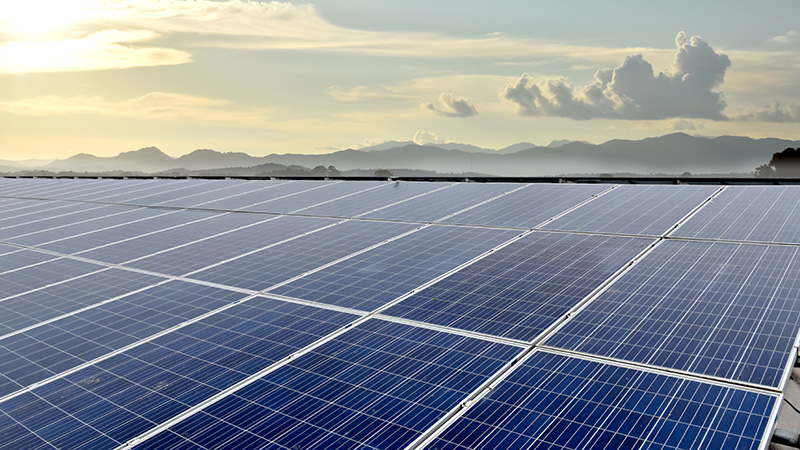
Energy produced from solar is growing rapidly in Aotearoa New Zealand as equipment costs decrease and commercial-scale installations come online, with more, bigger facilities being planned.
The obvious limitation though is daylight and the fact solar production is normally highest when demand for power is generally lower. Battery energy storage systems (BESS) address this, stabilising supply, reducing load at peak periods, and reducing cost.
The Battery Industry Group is working to ensure the large batteries enabling solar production in Aotearoa are properly dealt with at their end of life in a systematic way, so they become a valuable part of a more sustainable energy sector.
This ranges from batteries in EVs or hybrids, which could potentially be used for energy storage at the end of their life in a vehicle, to those made specifically for energy storage.
Slow start but accelerating
The first time a New Zealand solar farm, Kohirā in Kaitaiā, sold electricity on the wholesale market was in December 2023. For context, that’s some 40 years after the world’s first large-scale solar farm began feeding the national grid in the United States.
Since then, four other large-scale solar farms have come online in Aotearoa, contributing around 1% to 2% of total grid energy production in 2025. The EECA (Energy Efficiency & Conservation Authority) forecasts a rapid rise from 2031, estimating production will increase from around 4.5 petajoules (1,250 gigawatt-hours) to between 29 and 44 petajoules (8,055 to 12,500 gigawatt-hours) by 2050.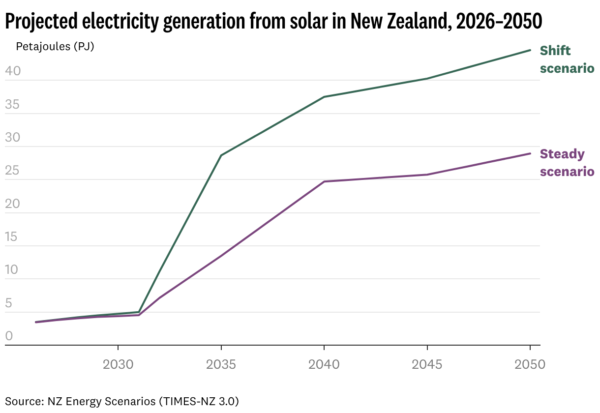
The difference between scenarios in the 2050 projection is large, as it depends on variables like changes to the energy sector and the economy, as well as future government policy signals, but still represents an uptick of between 544% and 877% over less than 20 years.
EECA predicts solar could account for as much as 12% of national electricity production by 2035. Investments by major players in the sector, including legacy energy generators and new companies, back this assessment. Meridian energy, for example, is building a solar farm at Marsden Point in Whangārei which the company says will have a capacity of some 130 megawatts – enough to power half of Northland’s homes – and generate up to 230 gigawatts annually.
The farm, called Ruakākā Energy Park, will have a 100-megawatt BESS to compliment the solar production. The company is also in the early stages of a proposed solar farm outside Christchurch which will have a 200-megawatt capacity.
There are other players which see a future for solar too. In June this year the country’s largest operational solar farm to date, Tauhei Solar Farm, began exporting power to the grid. The farm is a joint venture between Harmony Energy New Zealand and First Renewables and will generate 280 gigawatts annually.
The industry training sector is also responding. One of the largest private training providers, Skills Group, recently announced it’s expanding its specialist solar training courses from Auckland and Canterbury to five new regions.
Batteries are key
The ability to meet peak demand for power is one of the biggest challenges facing the New Zealand electricity sector. This isn’t just in terms of daily demand, but seasonal too, and is where BESS plays a critical role.
Hydro schemes account for up to 60% of the country’s electricity production. In dry summers this can drop considerably – down to below 50%. The effects of climate change are another factor, causing increasingly erratic weather patterns which can create unexpected imbalances between generation capacity and demand.
If solar is going to help fill the gap, then BESS systems will be needed to store energy for use after the sun sets.
For example, the recent cold blast which hit New Zealand at the start of August saw record demand for electricity on the morning of August 6, with the wholesale price skyrocketing by 2,500%.
BESS systems, both at commercial scale and in homes, would smooth this demand by charging during the day or overnight when demand is low and then release it at peak periods.
Over the ditch, these systems are commonplace alongside large-scale solar farms. A report by Modo Energy shows Australia’s national electricity market has been ramping up BESS deployment since 2021 and by the end of 2025 had 5.6 gigawatts. Last year alone saw a particularly fast expansion, with new installations more than doubling capacity.
Local solutions to reduce cost
The cost of electricity is a major driver of inflation, with the industry signaling price increases are set to continue.
The most recent report by Rewiring Aotearoa, a non-profit working to accelerate the country’s transition to a low-cost electrified economy, shows an ever-increasing gap between the price index of grid electricity vs solar modules and battery cells.
The report shows the cost of electricity produced by a home solar system (on 5.5% finance) is significantly lower than other forms of energy (grid electricity, LPG, petrol and natural gas). Even a system using a mix of solar, battery storage, and grid power, as is the case for many residential setups, has been cheaper than grid power since 2025.
The report also notes that a solar and battery system has significant positives not accounted for in the price alone. For example, using energy stored in the battery at peak periods reduces load on the grid, and provides resilience during outages or during natural disasters.
Solar is undoubtedly set to become a significant source of energy and batteries go hand in hand with it.
The Battery Industry Group (B.I.G) is focussed on establishing an all-of-industry scheme that ensures batteries in New Zealand are designed, used, and disposed of safely and sustainably. For example, making it possible for EV batteries to be used as home energy storage when they are no longer useful in a vehicle.
Learn more about the work B.I.G is doing, visit www.big.co.nz